Hurricane !
In 1895, the Tea Clipper Cutty Sark was 25 years old and, by the standards of the time, nearing the end of its commercial life. Steamships were the future and Cutty Sark’s owner, John Willis, was 78 years old. He was not married and had been reducing the size of his fleet for some time, planning to retire from business and dispose of the remainder as soon as possible. He found a buyer for his old clipper in Portugal where the Ferreira Company acquired her for £1,250. That proved to be a bargain as she carried on earnign them good money for another 27 years. When they bought the ship, her new owners re-named her Ferreira but, as you probably know, sailors the world over are a superstitious bunch and it is considered unlucky to change the name of a ship, and so they went on calling her “Pequena Camisola”, which is Portuguese for a short chemise, or a ‘cutty sark’ in the language of Robby Burns.
Our story takes place in 1906, by which time the Portuguese full-rigged ship Ferreira was nearly 37 years old – an old lady by the standards of deep sea sailing ships, but still fast, sound and busy earning money.
She sailed out of Lisbon on 30th June 1906, under the command of Captain Frederic Vincenzo da Sousa and arrived in Pensacola, Florida on 6th August, a passage of just under 4000 nautical miles in 37 days, ( av 108 m/d). This was her first visit to that port, although she had several times previously called at New Orleans, Louisiana, 150 miles to the west.
Although we do not have the manifest for that voyage, we do know that in 1906, the port of Pensacola, was a major, bustling hub for the export of forestry products, with lumber being one of the primary cargoes loaded onto ships. During this period, the city had become the state of Florida’s premier lumber centre, with numerous sawmills producing finished timber for export in vast amounts shipped from the city’s 16 major wharves. Another important export was coal from Alabama and both commodities were loaded into ships on Muscogee Wharf.
Pensacola was equipped to handle various vessels, including schooners, barques and steamers, many of which arrived in ballast to take on cargo, so it is reasonable to assume that Ferreira was one of those.
When her turn came, she was moved onto Muscogee Wharf. In this picture from around 1900, we can see there are four parallel rail tracks running the length of the wharf to carry the cargoes out to the waiting vessels.
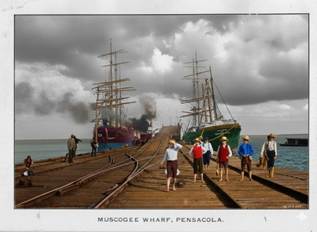
Over the next few weeks she loaded her cargo of timber destined for Rio de Janeiro and had taken on about 2/3 of her cargo when disaster struck.
Everyone living around the Gulf of Mexico knows that August, September and October is Hurricane Season. Schoolchildren in that part of the world are taught the rhyme :
“June – Too soon
July – Stand by !
August – Come it must
September – Remember …
October – All Over.”
So, although the arrival of hurricanes is expected every year, what can never be predicted is what route they will take and what intensity they might develop.
The busy port of Pensacola, Florida, was well used to hurricanes but in 1906, there were no easy ways to warn of the approach of a hurricane. No satellite, TV or radio, no telephones a few telegraph stations and only a very basic system of hoisting flags or cones to announce its imminent arrival.
In September that year, the sixth hurricane of the season began to gain strength in the Caribbean and head towards the coast. It was reported in newspapers on 25th September that it was passing the South Florida keys. A hurricane warning was issued and published in the newspapers the next day, storm signals were hoisted along the coast, but it was still far from clear just which path the storm would take, how strong it would become and where it would strike land. All the forecasters could say was that it was expected to make landfall somewhere between the west coast of Florida and south-east Louisiana and that it would be ferocious.
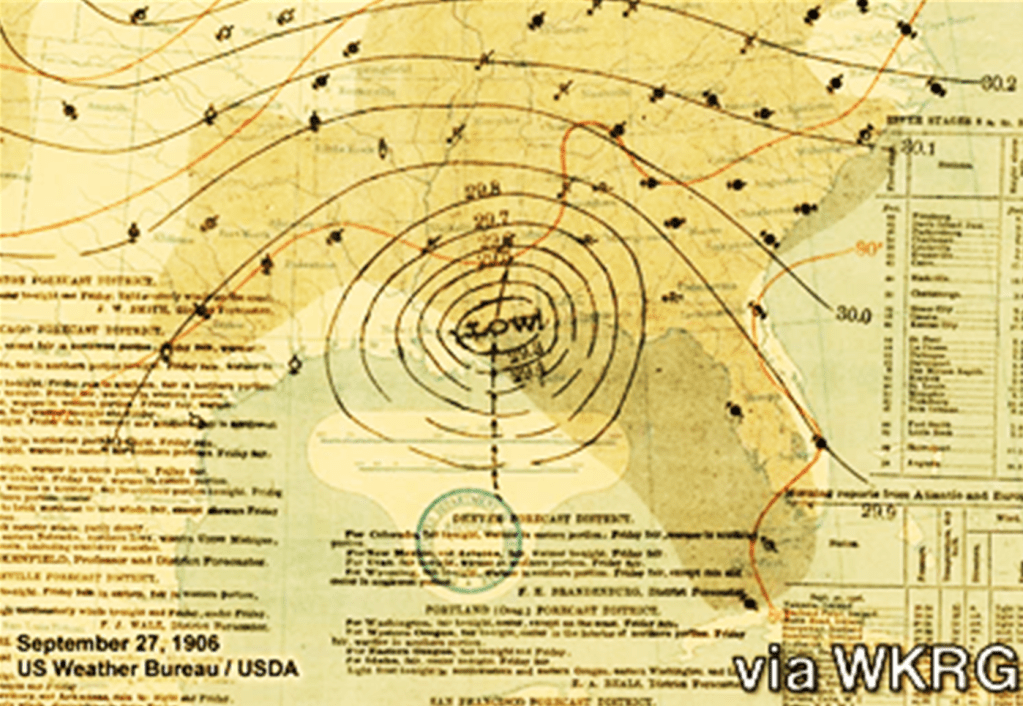
On 27 September the hurricane struck the shore just west of Pensacola and east of Mobile, Alabama, with a maximum wind speed of 110mph and a storm surge of more than 10 feet. Devastation was spread over a wide area.
It proved to be a Category 4 hurricane, the most destructive storm to strike the Pensacola area in 170 years. Winds in excess of 105 miles (170 kilometers) per hour tore through the city. Escambia Bay in the Gulf of Mexico saw a storm surge as high as 14 feet (4.3 meters).
Immense damage was wrought to Pensacola Harbour. The following day, the harbour was crammed with capsized and smashed vessels and their timber cargoes and lined with collapsed warehouses and shattered docks.
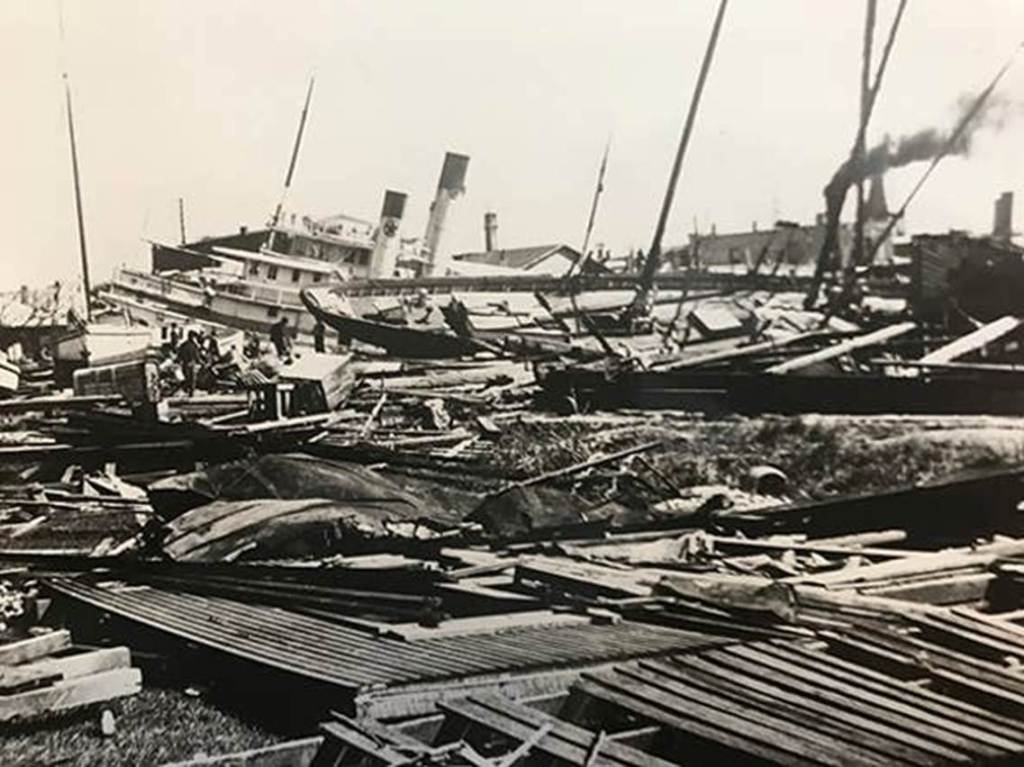
The storm caused the deaths of 134 people, more than 5,000 houses were destroyed and millions of dollars in damage done in Alabama and Florida.
So what happened to our beautiful old lady in the middle of all this chaos?
Ferreira was moored alongside Muscogee Pier, just ahead of a much larger Swedish iron barque, Alfhild, of 1,445 tons. Although Captain da Sousa doubled up his moorings and dropped his outboard anchor, neither vessel could do anything to avoid the full force of the hurricane.
Both vessels were torn from their moorings by the storm surge and crashed repeatedly against the pier, with tremendous force, tearing away massive timbers and reducing it to wreckage. Three of the four rail tracks on the pier were torn out and more than 30 railway trucks loaded with coal fell into the bay.
Alfhild then swept past Ferreira tearing along her port side and was finally brought to a halt when she embedded her iron bow into the old clipper.
The Pensacola Journal reported that “Alfhild, being an iron vessel, suffered comparatively little damage compared with that inflicted to other vessels in the harbor. Ferreira, being a wooden ship, was more badly injured”.
It is an ironic coincidence that the Alfhild had been built in 1876 as the Rockhurst by Archibald McMillan & Son, whose yard was immediately opposite where the Cutty Sark had been built at Dumbarton.
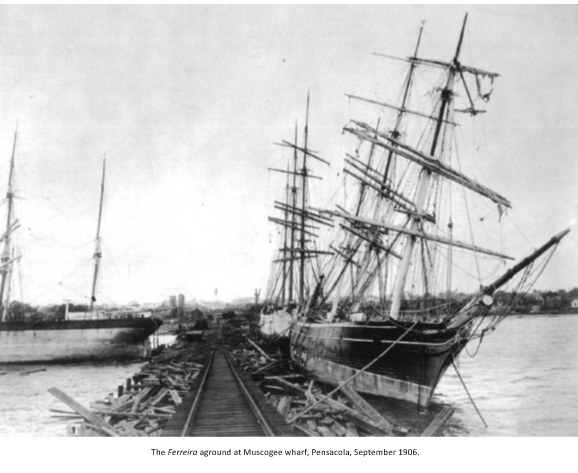
Here, Ferreira is in the foreground with Alfhild abaft with her bowsprit rearing above the Ferreira’s stern. Bent rails from the outer track are to be seen among the debris. Three of the four rail tracks are gone. It would take weeks just to clear the harbour to tow out those damaged vessels that could still float.
The next news of Ferreira was a report on 28 December, 3 months after the storm, that a repair contract had been placed with the Gulf Machine Works, who were to have her towed to Mobile ‘where she will be docked and repairs made to her hull. Her stern has been badly damaged and a big anchor from another vessel was driven through the hull . . . which caused her to sink. The anchor has been removed and temporary repairs made’.
Mobile is about 90 nautical miles away. When she left was not reported, but on 8 January 1907 the newspaper said that Ferreira, ‘towed to Mobile a week ago, returned to Penscola Sunday night’, so she can only have been in dry dock for a few days She had, however, also ‘suffered other damage, particularly to the stern, but this can be repaired . . . without docking the ship’.
With all that devastation in the area, it must have been touch and go whether this old ship was worth all the trouble. Probably a significant person in the decision to repair her was a local businessman, Mr F.F. Bingham. He was secretary of the Southern States Lumber Company as well as a shipbuilder and owner at Pensacola. and was greatly impressed by the Ferreira, though at that time did not know that she had once been the Cutty Sark. Bingham recognised something special when he saw it. He recorded in his journal: ‘Her lines “alow and aloft” completely satisfied the eye’. He considered buying the ship after the hurricane, but the owners would not sell her, so when her repairs were completed, he chartered her to take his lumbar to Rio.
Finally, she cast off and set sail, on 24th March 1907, nearly 8 months after her arrival.
Captain da Sousa must have breathed a sigh of relief when she slipped her mooring lines and left Pensocola astern.
But the story did not finish there.
Não conte com a vitória antes da hora.
On 2 April 1907, only eight days after leaving Pensacola, Ferreira ran aground on the Cosgrove Shoal near Key West.
This submerged hazard lies 7 nm ESE of the westernmost of the Marquesas Keys. Captain da Sousa could be forgiven for this accident as the shoal was unmarked until 1935, when a tower was installed which stood in only 14 feet of water, seven feet less than the Ferreira’s maximum draught.
There was no mention of severe weather, so it would seem that Ferreira had rounded the last in the long chain of islands which guards the northern side of the Straits of Florida and then stumbled onto the shoal.
The old lady was able to float off without assistance, but her rudder had broken and she has sustained other damage, the steering gear was disabled and she was leaking considerably. Several unsuccessful attempts to take her in tow followed so a government tug was sent to her aid and took her into Key West for repair.
A report from Key West dated 5 June says: “The rudder . . . has arrived at the Curry Shipyard, and . . . is an immense one . . . [T]o get it in place the ship will have to be towed up into Man of War Harbor [at Fleming Key, north of Key West island], where there is 32 feet of water. [It] could have been made here, but there was no piece of timber large enough to cut it from.”
Ferreira returned to Key West on 17 June 1907 with her new rudder and finally resumed her passage to Rio de Janeiro without further adventures, reaching there on 17 September, more than thirteen months after her arrival at Pensacola.
Our lucky old ship had survived yet another close shave; surely she could now look forward to a peaceful old age?
Not a chance!
GT 28.3.26
 Site Title