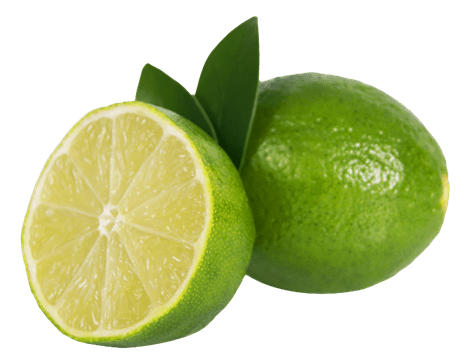
The terrible story of scurvy and the immense toll it took for centuries on deep-water sailors is described elsewhere. In this article we pick up the story at the time when lime juice has become established as the means of prevention and cure of scurvy, but how was it procured, stored and dispensed?
The sailor’s saviour
Credit for the introduction of lime juice, initially to the Royal Navy and later to British merchant ships, must go to the Scottish physician Sir Gilbert Blane (1749-1834) who was appointed by Admiral Rodney as Physician to the Fleet in 1779. Blane was a medical reformer who was convinced by Lind’s original experiments that showed citrus fruit to be effective at treating scurvy and Blane appreciated the need for a practical way of storing it on long sea voyages. Previously all attempts to store lemon juice, for even relatively short periods, rendered it useless.
After considerable experimentation, Blane found that adding 10% alcohol to lemon juice preserved it almost indefinitely, without destroying its beneficial properties. It was so effective that he was able to persuade the Admiralty to introduce a daily supplement of lemon juice to sailors’ diet. From 1795 onward, three-quarters of an ounce of lemon juice per day was mandated to be given to every sailor serving in the Royal Navy, virtually banishing scurvy at a stroke.
Lemon juice becomes lime juice
Although Blaine’s policy was hugely beneficial, it brought with it considerable procurement challenges because citrus fruits cannot be grown in Britain. In 1804, for example, the Navy Board had to source 50,000 gallons of lemon juice, which typically came from Spanish fruit—and Britain was at war with Spain. As a result, the board switched to lime juice, which could be obtained from British possessions in the Caribbean.
Unfortunately, lime juice is a less effective antiscorbutic (scurvy preventer) than lemon juice, so the daily ration was increased to 1 ounce per man, per day, to compensate for this.
Other navies were slow to follow, because of cost or, in the case of Spain with its ready source of lemons, because it was prohibited to give alcohol to sailors.
Some viewed the Royal Navy’s practice as bizarre. In the Anglo-American War of 1812, U.S. sailors ridiculed their opponents as “Limeys” (the origin of the term still in use today. British ocean-going merchant ships were generally referred to by others as “Limejuicers”.
An industry is developed
With the benefit of our current understanding, we now know that ascorbic acid reacts with oxygen in the air to form ascorbate ions. In the body these form calcium or sodium salts and consequently, a loss of therapeutic benefit. This was not understood until the 1950s.
150 years earlier, Blane’s experiments showed that if lemon or lime juice was to retain its antiscorbutic value during long periods of storage at sea, several conditions must be met.
The importance of correct storage
To ensure the lime juice retains its therapeutic value, the following conditions were essential.
- 10% alcohol should be added to the juice to extend its life.
- It must be kept in air-tight containers until needed. Once exposed to the air it must be consumed quickly before it has time to deteriorate.
- It should not be stored or measured out in metal containers or utensils as these accelerate the deterioration process.
- It should be kept away from heat as far as possible.
- It should be kept in the dark or in opaque containers.
The most significant of these conditions was the need to add alcohol to the lime juice. Because this brought implications for tax and duty, the government had to implement a range of procedures and safeguards to control it.
The production of lime juice, its bottling, storage and distribution to ships was therefore placed under the control of HM Customs and Excise through the Board of Trade.
In the British plantations of the Caribbean, freshly-picked limes were pressed to extract the juice using wooden (metal-free) equipment and stored in wooden barrels for transportation to Britain. Because barrels will always contain an air space, a little olive oil was added which floated on the surface of the juice, creating a barrier that prevented the air from reaching it.
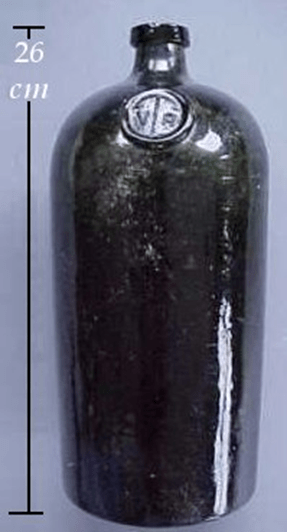
On arrival in Britain, the juice was mixed with alcohol, under strict Excise supervision, to render it 15% proof. It was then transferred to glass bottles bearing the HM Customs mark, made from black glass to protect the juice from daylight, filled to the top to exclude as much air as possible, then sealed and embossed with the Customs mark.

The lime juice was stored in bonded warehouses where its quality and alcohol content were checked by teams of Revenue appointed “Lime Juice Inspectors”.
Bottles were labelled with details of their date of inspection and distributed to licenced ships’ chandlers for sale only to ships.
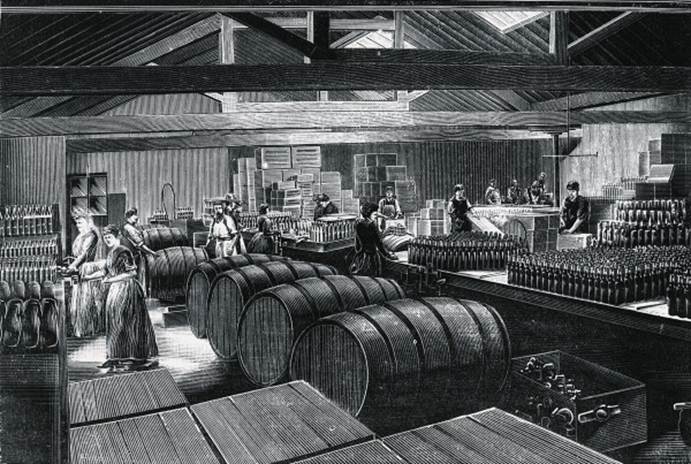
At sea, once a bottle of juice was opened, its therapeutic value quickly deteriorated through exposure to the air, so bottles of various sizes were available to suit the daily ration for an entire ship’s complement.
The daily allocation of lime juice
The allocation of lime juice to sailors during deep sea voyages was strictly controlled by the Merchant Shipping Act (1867).
To be sure that the juice was consumed as soon as possible after the bottle was opened, this would be done at the change of watch (8-bells) when everyone was up and about. Typically, this would be at 8 bells (noon) every day. The Cook, or sometimes the Steward, would serve out the lime juice, mixed with sugar to make it more palatable.
The Act required that after 10 days sea, each man to be given 1 ounce (30 ml) of lime juice each day for the remainder of the voyage (unless in harbour and fresh provisions were available). It was not optional; any man refusing to take his lime juice ration would be reported to the Captain and the offence recorded in the Ship’s Log. This required that whoever issued the ration, needed to keep a daily record of who had received it.
After the ration had been issued to everyone on board, any lime juice remaining in the bottle would be discarded and a new, sealed bottle used the following day. (Left-over juice was often used for cleaning brass and other brightwork (see later).
The quantity of lime juice consumed
On ships making long voyages, the total amount of lime juice carried was considerable. On Cutty Sark, with a maximum ship’s complement of 30, one quart bottle (946ml) would provide the ration for one day for all on board. On passages often lasting over 100 days, she would consume at least 25 gallons (100+ bottles) and perhaps 300+ bottles during a complete voyage. On Royal Navy ships with much larger crews, the challenges were enormous. In one period of 20 years, 1.6 million gallons of lime juice was issued to Royal Navy ships. Over that same period, cases of scurvy in the Royal Naval Hospital fell from nearly 1,500 to 2.
Scurvy is finally beaten
Between 1500 and 1850, scurvy killed more than two million sailors, typically 50% of the crew on any major voyage, sometimes many more. Scurvy was responsible for more deaths at sea than storms, shipwrecks, combat, and all other diseases combined. After the introduction of the daily lime juice ration, scurvy on British ships was virtually eradicated.
Today, both scurvy and lime juice have disappeared from ships thanks to the introduction of refrigeration.

Vitamin C crystals, as seen through a polarized light microscope.
It was not until 1927, several years after Cutty Sark had made her last commercial voyage, that ascorbic acid, the mystery therapeutic ingredient of citrus fruit was finally isolated by Hungarian biochemist Szent-Gyorgyi who showed it to be a vitamin, the third vitamin to be identified, hence “Vitamin C“. Szent-Gyorgyi was awarded the Nobel Prize for Medicine in 1937.
The Lime Juice exhibit on Cutty Sark
Very few examples of original lime juice bottles have survived, presumably because they were tossed overboard after use.
The RMG Collection includes only fragments of one such bottle ! (GGG0456)
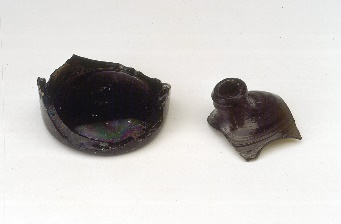
Replica bottles and labels have therefore been produced based on the best available information.
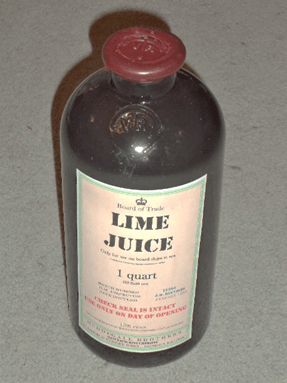
Black glass bottles are used to avoid deterioration through sunlight
Bottles and wax seals carried the official Board of Trade mark to reduce forgery.
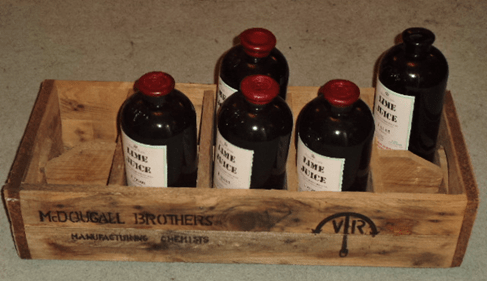
One crate at a time would be brought up from foc’s’l stores to provide for 1 week’s ration
McDougall Brothers were one of a number of companies licensed by Board of Trade to fortify and bottle lime juice. This was then sold on, in bulk, to a network of approved chandlers for sale to ships.
The crate also carries the Customs and Excise mark
↔ All lime juice for ships at sea was sold under the control of the Board of Trade to ensure quality and that Excise duties were paid.
Board of Trade Lime Juice Only for use on board ships at sea As stipulated by The Merchant Shipping Amendment Act (1867§4) 1 quart (32 fluid ozs) Batch number 12395 H.M. Inspector J.M. Reynolds Date bottled January 1882 Check seal is intact use only on day of opening 15% PROOF SOLD UNDER LICENCE OF HER MAJESTY’S CUSTOMS AND INLAND EXCISE |
| M c D O UG A L L B R O T H E R S MANUFACTURING CHEMISTS 11 ARTHUR STREET WEST, LONDON BRIDGE. |
Precise conditions for storage, sale and serving out are laid down in the Act.
↔ Various sizes of bottles were available to suit the daily ration for the entire ship’s complement so that ration is always fresh
↔ Each batch is checked by an official Lime Juice Inspector appointed by the Board of Trade and labelled before distribution.
↔ Precautions to be followed to ensure the juice has not deteriorated and is used immediately after opening.
↔ Alcohol assists preservation which means it needs to be controlled by HM Customs
↔ Distributed through licenced chandlers
Merchant Shipping Act (1867) (extract)
FIFTH SCHEDULE REGULATIONS TO BE OBSERVED WITH RESPECT TO ANTISCORBUTICS.
Furnishing of Anti-Scorbutics.
(1) The anti-scorbutics to be furnished shall be lime or lemon juice, or such other anti-scorbutics (if any) of such quality, and composed of such materials, and packed and kept in such manner as Her Majesty by Order in Council may direct.
(2) No lime or lemon juice shall be deemed fit and proper to be taken on board ship, for the use of the crew or passengers thereof, unless it has been obtained from a bonded warehouse for and to be shipped as stores.
(3) Lime or lemon juice shall not be so obtained or delivered from a warehouse as aforesaid, unless—
(a) it is shown, by a certificate under the hand of an inspector appointed by the Board of Trade, to be proper for use on board ship, the certificate to be given upon inspection of a sample, after deposit of the lime or lemon juice in the warehouse; and
(b) it contains fifteen per cent. of proper and palatable proof spirit, to be approved by the inspector or by the proper officer of customs, and to be added before or immediately after the inspection thereof ; and
(c) it is packed in such bottles at such time and in Such manner and is labelled in such manner as the Commissioners of Customs may-direct.
(4) If the lime or lemon juice is deposited in a bonded warehouse, and has been approved as aforesaid by the inspector, the spirit, or the amount of spirit necessary to make up fifteen per cent., may be added in the warehouse, without payment of any duty thereon; and when any spirit has been added to any lime or lemon juice, and the lime or lemon juice has been labelled as aforesaid, it shall be deposited in the warehouse for delivery as ship’s stores only, upon such terms and subject to such regulations of the Commissioners of Customs as are applicable to the delivery of ship’s stores from the warehouse.
(5) The lime or lemon juice with which a ship is required by this Act to be provided shall be taken from the warehouse duly labelled as aforesaid, and the labels shall
remain intact until twenty-four hours at least after the ship has left her port of departure on her foreign voyage.
Serving out of Anti-Scorbutics.
(6) The lime or lemon juice shall be served out with sugar (the sugar to be in addition to any sugar required by the agreement with the crew).
(7) The anti-scorbutics shall be served out to the crew so soon as they have been at sea for ten days; and during the remainder of the voyage, except during such time as they are in harbour and are there supplied with fresh provisions.
(8) The lime or lemon juice and sugar shall be served out daily at the rate of an ounce each per day to each member of the crew, and shall be mixed with a due proportion of water before being served out.
(9) The other anti-scorbutics, if any, provided in pursuance of an Order in Council shall be served out at such times and in such quantities as the Order in Council directs.
Lime juice as part of every seaman’s life.
Yarns of an old shellback : J.L. Vivian Millett; Methuen (1925)
On board The Tweed (1882)
The Steward was an old, old man who had sailed with Captain White for many years. He was a Scotsman and extremely mean; he hated the men, and they heartily reciprocated the feeling. I can see him now serving out the lime-juice according to the Act, and it seemed to me that he took a positive attitude in making his hands and arms as dirty as he could with scrubbing the cabin floor before dipping them into the bucket of lime-juice to stir up the sugar at the bottom.
On board Cutty Sark (1894)
Another reference appears in one of Apprentice Clarence Ray’s many letters home from Cutty Sark (15.7.1894):
“We get a pannikin of lime juice every day at 12 o’clock”
Corroboration that lime juice was brought on board Cutty Sark in glass bottles is to be found in Capt, Moore’s papers from the voyage of 1882/3. Amongst these is a Stores Requisition Receipt signed by Chief Mate Syvret, which reads:
November 18th 1882 – “Received stores on board damaged –
One bag of sugar – damaged
One bottle Lime Juice – broke”
Shanty sung by Stan Hugill on board Cutty Sark at the Greenwich Festival (1979)
“The Limejuice Ship / According to the Act”
Now if you want a limejuice ship to sail the seas at large,
You’ll not have any trouble if you have a good discharge,
Signed by the Board of Trade, and everything exact,
For there’s nothing done on a limejuice ship contrary to the Act.
Chorus (after each verse):
Shout, boys, shout, I tell you it’s a fact,
There’s nothing done on a limejuice ship contrary to the Act.
Now when you board a limejuice ship you’ll hear your articles read,
They’ll tell you of your beef and pork, your butter and your bread,
Your sugar, tea and coffee, boys, your peas and beans exact,
Oh, your limejuice and your vinegar, boys, according to the Act.
No watch-and-watch the first day out, according to the Act,
Ten days out we all lay aft to get our limejuice whack,
Fetch out her handy billy, boys, and clap it on the tack,
For we’re going to set the mainsail, oh, according to the Act.
It’s up on deck, my bully boys, with many a curse we go,
A-waiting to hear eight bells struck that we may go below,
Eight bells is struck, the watch is called, the log is hove exact,
Oh, relieve the wheel and go below, according to the Act.
So haul, boys, your weather mainbrace, and ease away your lee,
Hoist jibs and topsails, lads, and let the ship go free,
Hurrah, boys, hurrah, we’ll sing this jubilee,
Oh, damn and bugger the Navy, boys, a merchant ship for me!
Ultramarine – Malcolm Lowry (1974)
Lowry refers to Board of Trade lime juice in his novel Ultramarine when Dana is cleaning the floor of the messroom on board the Oedipus Tyrannus; “Here you are then. If you put some Board of Trade lime juice in that it’ll come as white as a lamb’s arse…” and “In the bucket is a mixture of soda and hot water. To this he adds three drops of lime juice, Board of Trade bottle, price 15s.” – a task probably reflecting Lowry’s time on the Pyrrhus.
There are other references that it made a good cleaning substance.
Conversions
Daily ration – per man/per day = 1 fluid ounce = 30ml
Stored in bottles of 1 quart. 1 qt = 946ml (larger sizes available)
1 quart = 2 pints; 4 quarts = 1 gallon
Daily ration for 30 men = 30 fl oz = 30 x 30 = 900 ml
Alcoholic beverages are rated in Proof. UK and US systems are different. In the UK, proof is defined as: “a quantity of 100 degrees proof liquor has the same weight as 12/13 of the same volume of pure water at 51 °F.”
Hence, 100% proof liquor contains 57.15% ABV (Alcohol By Volume)
100% (pure) ethyl alcohol is rated 175% Proof
gt: 20.10.24
 Site Title