In 1846, in Boyton, a small coastal village in Suffolk, Mary Hart gave birth to a baby boy that she named William but, being the 19th century, he would forever be known as Billy. His mother died soon after giving birth. As a child aged 6 he was living with his Grandparents, who were still both listed in the records as agricultural labourers even though by then they were both approaching 70 years of age.
Billy Hart had an adventurous spirit – he couldn’t see a future following his grandparents’ path as a farm labourer, so at 13 he found work on a local fishing boat, where he learned respect for the sea. But clearly he had ambitions to see more of the world and he signed on as an Ordinary Seaman aboard a deep sea sailing ship and after 3 years he became an Able Seaman.
In March 1874 he found himself in Sydney, Australia, looking for a ship that would get him back to England, when the beautiful and famous tea clipper Cutty Sark moored up at Circular Quay, looking for crew to replace nine men who had deserted the ship to make their fortune in the gold fields. He signed on as an Able Seaman under Captain Tiptaft who brought them safely back to London in October.
Normally, when a ship returned to its home port, the Crew were paid off that same day and, with little by way of savings from their wages, they would immediately start to look for the next ship to be signing on a crew. But Billy had really enjoyed his time on Cutty Sark, this was the sort of seafaring he had always craved. He learned that she was due to load almost immediately and sail in less than 3 weeks, so he determined to try to get back on board for the next trip.
As soon as he heard that Cutty Sark would be taking on a crew the following day, Billy was the first man up the gangplank with his sea bag over his shoulder. Captain Tiptaft had been impressed with Billy on the last trip back from Sydney and had no hesitation in signing him on again.
Cutty Sark, under the command of Captain Tiptaft for the second time, left London on Saturday November 14th 1874 under tow from a steam tug as far as Gravesend, where she set sail and headed out into the English Channel bound for Australia and on to China.
As was so often the case at that time of the year, she turned into the channel right into the teeth of a South-Westerly gale. Captain Tiptaft had no choice but to beat his way westwards, that’s to say, he had to tack back and forth against the gale, between the French and English coasts to try to make some westerly distance.
It was a painfully slow business, fighting against the fierce gale, the crew getting precious little rest and by daylight three days later, on Monday the 16th, she had still not managed to get past the Isle of Wight.
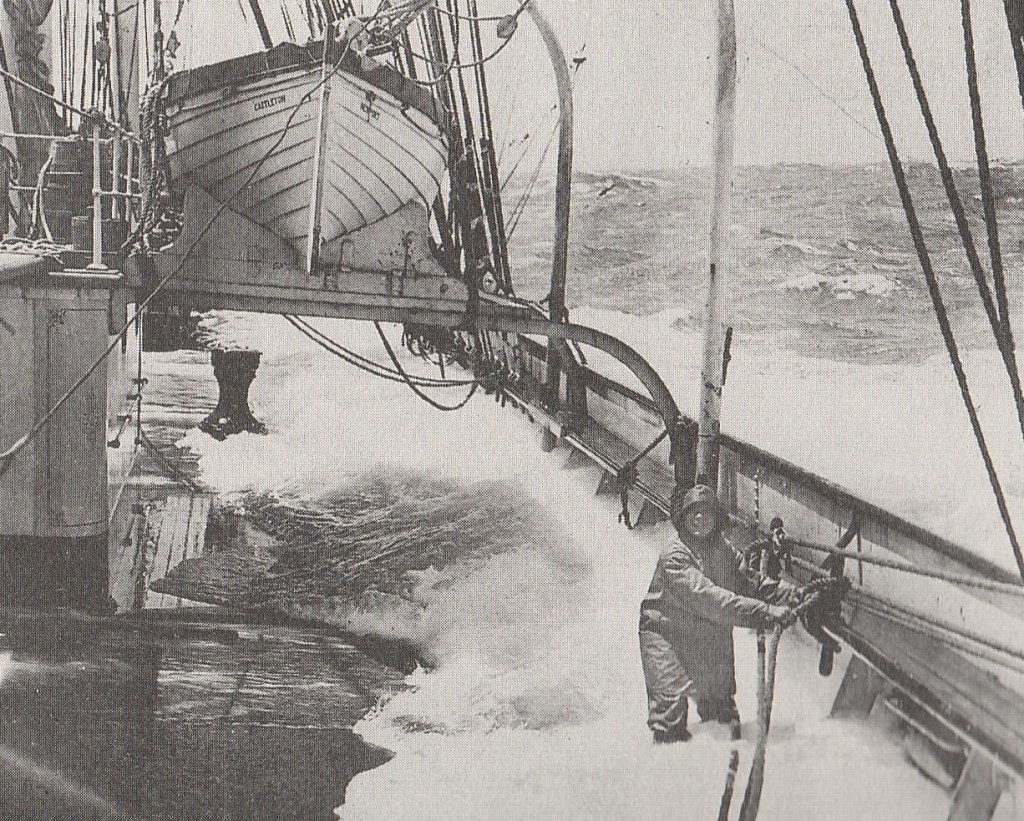
As she approached St. Catherine’s Point, the southernmost point on the Isle of Wight, she was braced hard up on the port tack. The clipper was heeling far over to starboard, with the lee rail beneath the water. Captain Tiptaft needed to keep well off the lee shore to avoid being carried towards The Needles, so he gave the order to tack ship once again.
As the helm was put down and the ship swung to port towards the wind, a huge sea broke over the starboard rail, which was already under the water. The wave rushed inboard and smashed into the group of men grappling with the main starboard tack. It knocked several of them off their feet, but it didn’t stop there. The same wave picked up Billy Hart and carried him over the starboard rail. He vanished within seconds – most seamen like Billy could not swim, they considered it unlucky!
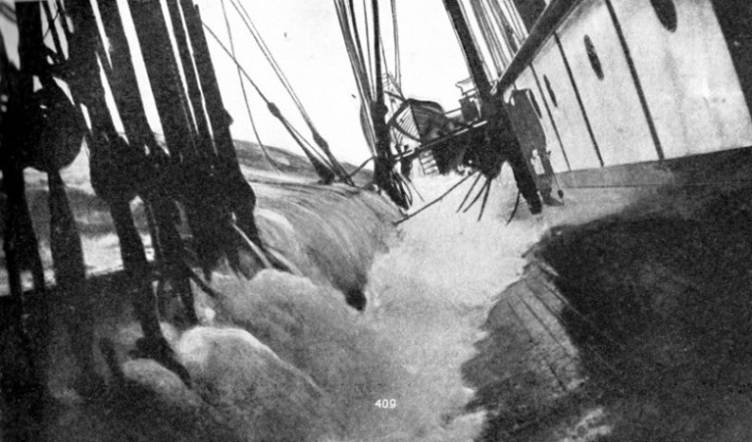
The starboard rail takes a dive beneath the waves
The fierce gale and heavy seas made it impossible to launch a lifeboat. If they had tried, the boat would have been smashed to pieces against the side of the ship and its crew most likely also lost. Captain Tiptaft had no alternative than to complete the manoeuvre and put the ship safely about onto the starboard tack, heading towards the French coast.
The loss of Able Seaman William Hart was duly recorded in the log. The law required his wages to be paid to his next of kin, assuming any relatives could be traced. Since the voyage was only a few days old when Billy was lost, the wages due to him were just £1-13s-10d or £1.69 pence.
As soon as the weather eased, tradition required Billy’s few possessions to be auctioned off amongst the crew at the foot of the foremast. His effects would not have amounted to very much. His most valuable possessions, his sweater, his oilskins, seaboots and his knife had gone with him to Davy Jones’ Locker and the meagre proceeds of the auction of what was left, which amounted to a more than generous £4-12s or £4.60, was added to the payment that would go to his relatives when the ship returned to London in October the following year.
That would also be when news of Billy’s death first reached his relatives, if they could be traced.
These clippers were not just beautiful and powerful racing vessels, they could be lethal killing machines and for the men who sailed them, life was tough, downright dangerous and often short.
Billy Hart was the first man to be lost overboard from Cutty Sark since her launch 5 years earlier; tragically, he would not be the last. In the 25 years that she was under the Red Ensign, 5 more men would follow Billy to a watery grave; but by the standards of the day, that made Cutty Sark a lucky ship. Most of these ocean-going sailing ships would reckon on losing one or maybe two members of their crew on every voyage.
Despite the dangers and the privations of life at sea, deep-sea sailors like Billy developed immense pride in their knowledge and skills. At the turn of the century, when they were obliged to move into steam ships, because this way of life was fast disappearing for ever, they talked of it as “Leaving the Sea”; all that skill and knowledge, acquired over a liftetime, was no longer needed.
So, when we are tempted to complain about the crowded conditions on the Jubilee Line, or the rain dripping down our necks at the bus stop, let’s just pause for a moment and think of Billy Hart. He would be amazed and proud that a sailor, with no family, whose total worldly possessions amounted to around £5, and with no grave but the sea, is still remembered and still talked about after 150 years, on the very same ship that he so loved and admired.
Gt: 20.6.21
 Site Title