HARNESS CASKS
As Cutty Sark had no means of refrigeration, it was not easy to keep food safe to eat on passages that could last for several months.
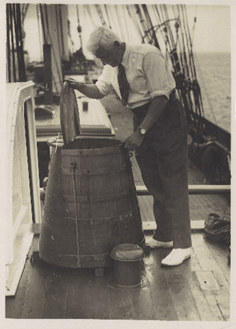
Meat was an essential part of the crew’s legal daily ration and was preserved in brine (salt water). It was stored on the poop deck in brass-bound oak Harness Casks like these, one containing salt beef, the other salt pork (both described by the crew as “tram horse”).
Cutty Sark also often carried several chickens and one or tw o live hogs or goats, kept in pens beneath the anchor deck, to provide the welcome addition of fresh eggs and meat during thps a e voyage.
More about ships’ Harness Casks
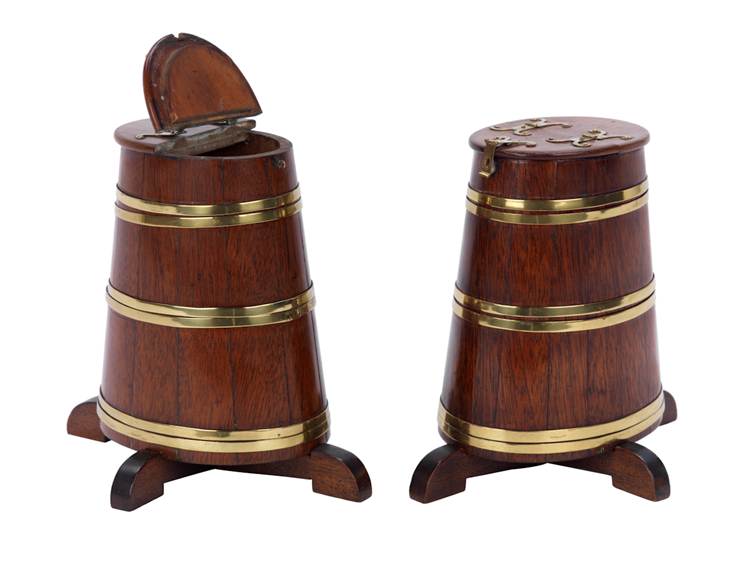
Cutty Sark’s harness casks
In 1954, Cutty Sark came to her permanent home in the purpose-built dry dock in Greenwich and work began to restore her, as closely as possible, to her original 1870 condition as a Tea Clipper. Offers of assistance in the form of materials and equipment came from a great many sources and amongst the contributors was the Royal Navy (8).
The then Director of the National Maritime Museum, Frank G.G. Carr, inspired the idea that she should be provided with Harness Casks, important elements of her upper deck equipment in her sea-going days and listed in the original specification for the ship.(11)
This pair of casks were paid for through contributions from 160 Coastguard stations around our shores. They carry the inscription:
“PRESENTED TO CUTTY SARK BY H M COASTGUARD 1956”
With the co-operation of the Admiralty, the Director of Victualling authorized these casks to be made at the Royal Victoria Victualling Yard, Deptford (today the site of the Pepys Estate).
The specification for the casks was drawn up by Mr R Bennett, the Admiralty’s Master Cooper with a lifetime’s experience of Admiralty work and one of the last men then alive with the knowledge of the traditional way in which such casks were made. The casks are slightly conical in shape, made from oak and brass-bound. Mr Bennett himself supervised their construction (1).
Where were they traditionally stowed?
Photographic evidence of the ship in the 1920s, whilst she was a sail training vessel in Falmouth(2) indicates that a pair of Harness Casks like this was stowed near the break of the poop deck, one on either side of the whaleback of the midships companionway.
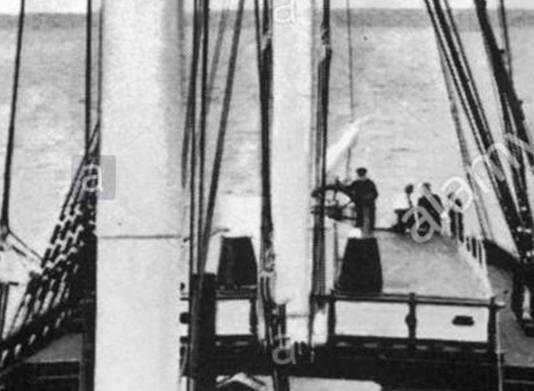
At first sight, it may appear odd that casks were stored on deck and not below in the fo’csle with other stores. An explanation can be found in Life in the Focsle by Frank C Bowen(3).
If the crew’s fo’csle was directly over the fore peak, in which the salt beef and pork barrels were stowed, their odour, mixed with that of old rope and tar kept there, made the air so foul that it was dangerous to take down a naked light.
Meat on SV ‘Monkbarns’ was kept in a locked, iron-bound teak harness cask on deck abaft the mizzen mast. There, it warped in the wet and heated in the sun until the surface ran with all the colours of the rainbow and care was needed in passing to leeward if you were fastidious (4)
The obvious disadvantage of stowing the casks on the open deck is that they are exposed to whatever the weather throws at them, sometimes so bad that the casks could be lost overboard. That is precisely what happened in May 1882, during Captain Fredrick Moore’s first command when Cutty Sark was 641 miles out of Sandy Hook. ‘The sea had, however, taken toll of her decks in the stormy weather. Two panels of the starboard topgallant rail had been burst in, the starboard boat was stove and the bow of the gig smashed, the harness cask was washed out of its lashings and overboard.’ (9)
“… Our Daily Bread”
The Articles of Agreement for Cutty Sark (7) state that each man’s ration must include 1 lb (450g) of “Bread” every day. But that did not mean the freshly baked soft loaf we know today (which sailors called “soft tack or Tommy”); for them “bread” meant ship’s biscuit, which they knew as “Hardtack” or “Pantiles”.
Made of only three ingredients (flour, salt, and water), the cracker-like food was baked numerous times to draw out any remaining moisture. Normally they would be circular, perforated with holes to aid baking.
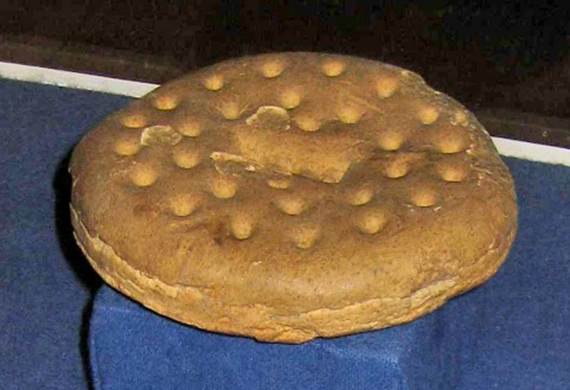
Practically inedible when issued to them, sailors soaked their hardtack in coffee or tea to soften it enough for eating.
While hardtack seemed impervious to the elements, moisture caused it to mould and become infested. Some sailors tried to remove the worms and weevils by banging their biscuit on the table before eating, for others the pests simply became an additional source of protein.
Known for its immensely long shelf life, there are still existing pieces of hardtack in the NMM Collection from Sir John Ross’s Arctic expedition of 1818.
Hardtack has come to signify all that was poor about the early seafaring diet. (10)
What’s on the menu today?
(From an old seaman’s journal)
“Lobscouse,” “dandy-funk,” “dogsbody,” “seapie,” “choke-dog”, “twice-laid” and “hishee-hashee” are among some of the delectable entrées which the sailor contrives to get out of his kid. Whatever is at hand is popped into these messes; nothing comes amiss, “from a potato paring to the heel of an old boot.”
“Soup-and-bouilli” is another standing sea-dish and, taking it all round, is the most disgusting of the provisions served out to the merchant sailor. I have known many a strong stomach, made food-proof by years of pork eaten with molasses, and biscuit alive with worms, to be utterly capsised by the mere smell of soup-and-bouilli. Jack calls it “soap and bullion, one onion to a gallon of water,” and this fairly expresses the character of the nauseous compound.
Sea-puddings, as there are scarcely any, have not many names. “Duff” means a large lump of flour and grease boiled in a bag; “doughboys” are the same flour and grease in smaller lumps. “Dough Jehovahs” are a Yankee pudding, and worthy of the people who first taught the British sailor to eat pork with treacle.
Tea is “water bewitched,” and no better title could be found for the pale yellow liquor thick with stalk-ends, which fill the sailor’s hookpot when he goes to breakfast or supper.
- Source unknown
Cutty Sark Recipe Book
(strong stomach needed!)
Dandyfunk
A favourite with the apprentices, a “treat” made from ship’s biscuits (hard tack) and molasses which they would often make for themselves when they could persuade the cook to let them near his stove.
Put a biscuit into a canvas bag and beat it into crumbs with a belaying pin. Tip the crumbs into your pannikin and mix it with a spoonful of lard and two spoons of dark molasses. Shape the mixture back into a biscuit and bake until it’s brown and bubbling.
Leu Pie (as described by Cutty Sark apprentice Clarence Ray (14)
“Leu pie is my favourite dinner it is cooked altogether in a great kid, fresh meat and spuds all in soup underneath and dough on the top. Oh Lor, I could eat 3 whacks of it now.”
Known on American ships as “Sea Pie”, it was well described by Philip Hichborn, ship’s carpenter(15). Hichborn swears it “proved very palatable,” but then he was comparing it to typical ship’s fare of things like cracker hash and dandyfunk.
“All the old pieces of the pig that the captain can’t eat, pieces of dough as large as your fist and as heavy as lead, as much water as will make it thin enough to swallow by giving your teeth a good greasing. Add pepper and salt to suit convenience of cook’s hand, depending upon whether it be large or otherwise. Put in a pan, place in an oven and let it stay until eight bells.”
Pea soup
Dried split peas, both yellow and green, have been known for thousands of years and at sea they provided a glimpse of variety in the relentless sequence of stews and hashes. Sometimes used as an addition to the stew kid and sometimes alone as pea soup. Always known as “pease”, sailors would claim that the test of a good serving of pease was that it could be eaten without the need of a plate!
For even greater variety, pease could be mixed with lumps of broken hard tack, known as seamen’s nuts, only soft enough to eat after they had been soaking in the soup for at least 20 minutes.
Lobscouse (or just “Scouse”)
A stew typically made from chunks of salt meat, either beef or pork, with potatoes and onion. It is particularly associated with the port of Liverpool, which is why the inhabitants of that city are often referred to as “scousers”.
Junk and spuds
When rope has lost its strength through age and heavy use it must be replaced. On board ship, old rope is known as “Junk” and is always put to some secondary use.
The salt meat that came out of the brine-filled harness casks, could be labelled as beef of pork, was universally known by the crew as “Tram Horse”. Cooked into stews it became “Junk”, which probably accurately described its texture.
A “spud” is a potato, one of the few vegetables that could be stored for some time on board ships at sea.
Fish
The crew would have little spare time for fishing other than whilst at anchor, but when sailing through certain latitudes, flying fish were common and often landed on the deck, particularly during the night.
“We get any amount of flying fish, they fly aboard at night, then all we have to do is catch them, cut their heads, wings, tails and fins off, clean them and then put them on a plate with some butter over them, and give them to Jimmy (cook James Robson) to cook for our breakfast. Last night I caught thirteen.”
Clarence Ray – Apprentice on Cutty Sark – 1894/5 (Ref 14)
Lime juice
Scurvy was responsible for more deaths at sea than storms, shipwrecks, combat, and all other diseases combined.
It had been known for centuries that citrus fruits both prevented and alleviated scurvy; their dilemma being that there was no way to store these fruits on long voyages.
The Merchant Shipping Act of 1867 required all British ships to provide all seamen with a daily lime ration to prevent scurvy, but the method of preparing the juice often reduced or even destroyed the effective component, which we now know to be ascorbic acid (Vitamin C).
IThe daily lime ration led to the term “limey“, first for British sailors, then for English immigrants within the former British colonies and finally, in old American slang, for all British people.
How is meat ‘salted’ to preserve it?
An 18th century cookbook The London Art of Cookery(13) contains a recipe for salting meat attributed to Admiral Sir Charles Knowles, who served in the Royal Navy between 1718 and 1779.

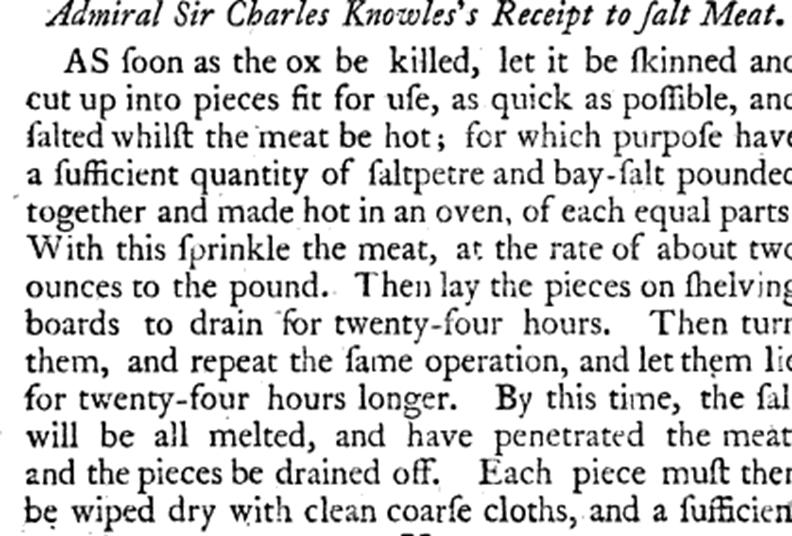
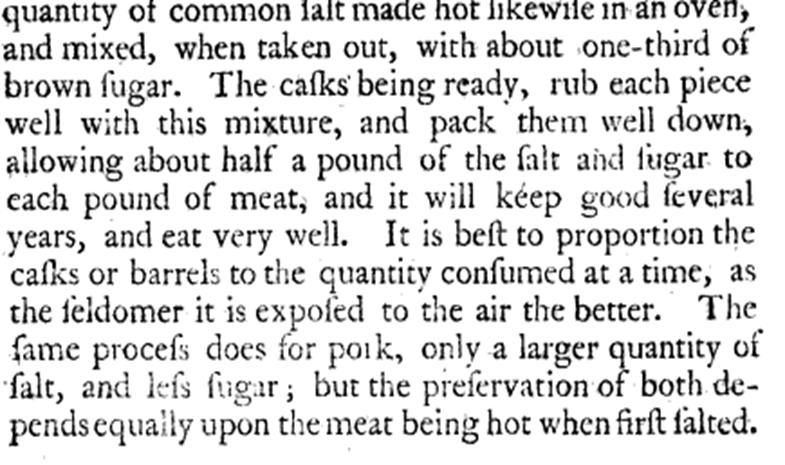
First, they dry-rubbed the fresh pork or beef with a mixture of sea-salt and salt-petre. The meat then went into a brine to remove the blood for five days, since blood can cause meat to spoil while in storage.
After removing it from the brine, the meat went into casks, with extra sea salt applied as each layer of meat was placed into the cask. The final step of the process was to cover the contents of the full casks with fresh brine, having enough dissolved salt in it ‘to float an egg.’
Each gallon of brine water used three and a half pounds of salt. To complete the salting process for one hundred pounds of meat, Navy victuallers used four and a half gallons of white salt and one and a quarter gallons of bay salt.
Sometimes, barrels of meat did not receive enough brine and crews neglected to check casks for leaks to make sure the meat needed more or new brine. Such incidents exposed the salted meat to air and increased the chances of it spoiling.
One further item of explanation is the author’s reference to the meat being “hot.” This meant fresh rather than cooked, fresh enough that the meat still retains the animal’s natural body heat.
Footnotes
Salt Petre is potassium nitrate (KNO3)
1 gallon = 4.54 litres
3½ pounds = 1.6kg
100 pounds = 45kg
LIST OF REFERENCES
- Press Release – Cutty Sark Society Press Bureau – County Hall, London – 20 Feb 1957.
- Photographs of Cutty Sark / Ferreira showing Harness Casks in-situ.
- Life in the Focsle by Frank C Bowen : Shipping Wonders of the World 1936
- Lost at Sea – a sailors’s life: © Jay Sivell
- Impact of diet on health and longevity in London 1850–1880: Peter Greaves – Journal of the Royal Society of Medicine Open; 11(9) 1
- Diets, Hunger and living standards during the industrial revolution : Past and Present, no. 239 (May 2018) _ The Past and Present Society, Oxford, 2018
- Agreement and Account of Crew – Cutty Sark (1891)
- Letter from Frank G G Carr to C G Jarrett (Dep. Sec. Admiralty) 11 April 1956.
- Log of the Cutty Sark – Basil Lubbock : Brown, Son & Ferguson – Glasgow 1924.
- https://www.rmg.co.uk/stories/topics/ships-biscuit
- Extract from Willis Company’s specification for the clipper ship Cutty Sark (1869).
- Letter from Frank G G Carr to Sir Gilmore Jenkins (P. Sec. M. of Transport) 25 May 1956
- The London Art of Cookery, and Housekeeper’s Complete Assistant – John Farley (1783).
- Letters Home – by Clarence Ray- apprentice on Cutty Sark – 1894/5 – RMG Archive
- Cruise of the Dashing Wave: Rounding Cape Horn in 1860 – Philip Hichborn, edited by William H. Thiesen – 2010: University Press of Florida
gt: 26/3/23
 Site Title
