4 – Captain James Smith Wallace
Voyage 10 (Part) to Voyage 12 ( in part)
1878 to 1880
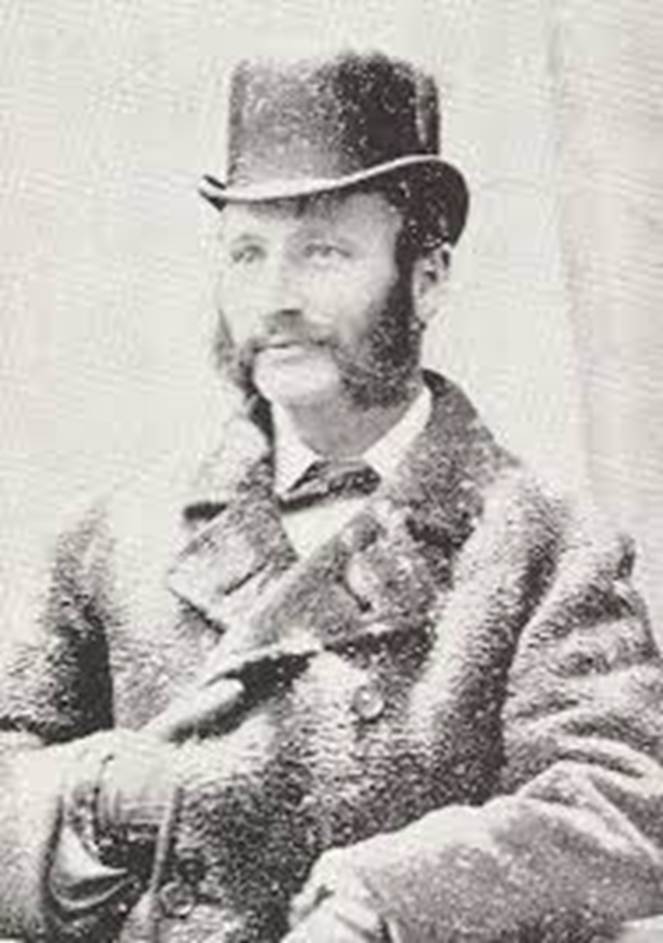
Wallace was the first mate on Cutty Sark’s 10th voyage when Captain Tiptaft was taken ill with dysentery and died on the 31st of October 1878 in Shanghai. No doubt there was a flurry of telegraphic communications between the agents in Shanghai and the Willis’ office in London as to who should take command in Captain Tiptaft’s place but in reality the decision was obvious – it was the very competent and able first mate James Smith Wallace .
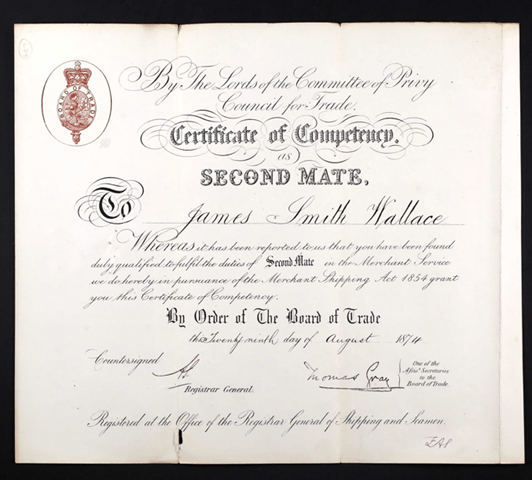
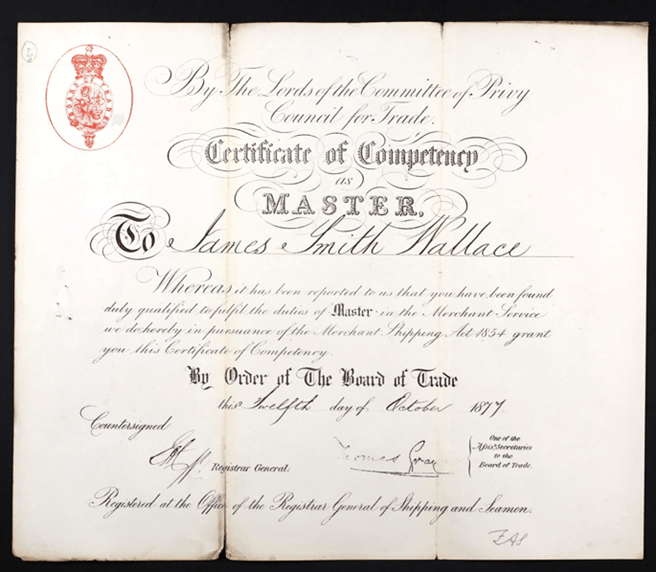
James Smith Wallace was a young man used to success; just 19 years old when he gained his second mate’s certificate and 24 when he received his master’s certificate and at 25 he now finds himself captain of Cutty Sark.
He came from a ‘family of standing’ as they would have said in the mid 19th century. Born on the 9th of January 1853 in Aberdeen, Scotland, the fifth of eight children. His father also James, had married Mary Ann Smith in 1845 and held the position of Inspector of Poor, which was an important post dealing with the Poor Laws and the distribution of poor relief and it was a position he held for all his working life. He lived to be 99.
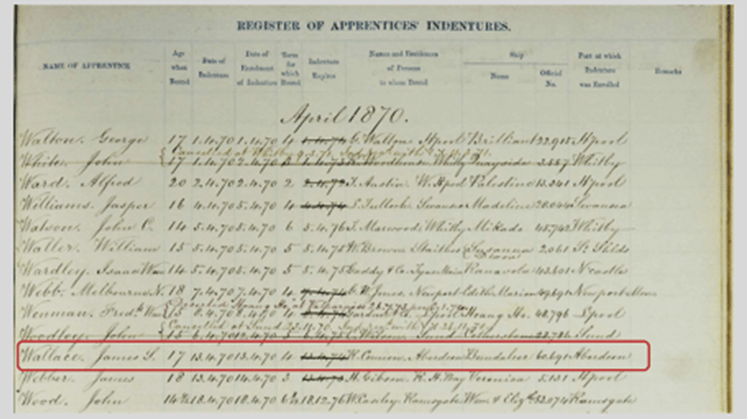
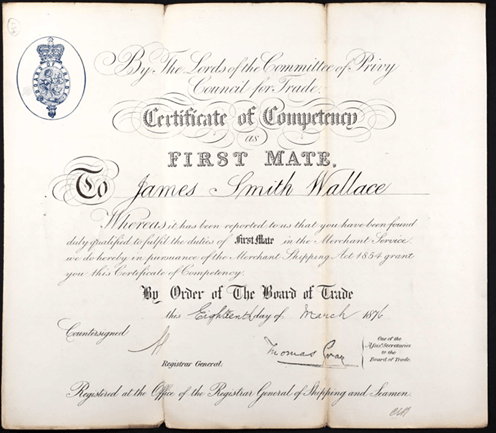
James junior began a 4-year apprenticeship indentured to Richard Conan of Aberdeen Conan on the 13th of April 1870 in the ship Bundaleer a 921 tonne ship-rigged vessel (similar to Cutty Sark). Three weeks before completing his apprenticeship on the 13th of April 1874 he joined Gordon Castle a steam-powered vessel, also owned by Richard Conan, as second mate. This was a little premature as he was technically still an apprentice and also hadn’t yet passed the examination for his second mate’s certificate, which he gained on the 29th of August 1874. Nevertheless he must have been a very competent seaman as two years later he had his first mate’s certificate.
Over the next three years he sailed in various vessels as second mate and then as first mate until, on the 1st of November 1877, he signed on as first mate on Cutty Sark for her 9th voyage bound for Sydney, even though the month before he had gained his master’s certificate. It was quite normal for those holding a master’s qualification to accept a position as first mate.
This voyage was curtailed by the damage caused by a storm which resulted in Cutty Sark having to return to port.
Wallace remained with the ship as first mate for the 10th voyage. In the days leading up to Captain Tiptaft’s death Cutty Sark was heading for Woosung with a cargo of coal from Nagasaki in Japan and arrived on the 12th of October 1878. After unloading the cargo, Captain Tiptaft decided to return to Shanghai once again for a cargo of tea. He became unwell on this short passage and was effectively a passenger by the time they reached port on the 25th of October Captain William Edward Tiptaft had developed acute dysentery and passed away on the 31st of October, a year since sailing from London.
Captain Wallace at 25 years of age, and taking his first command, continued with Captain Tiptaft’s search for a cargo of tea but found none, so on the 31st of December he departed Shanghai in ballast and sailed for Sydney.
A passage made in 51 days was completed with a cargo of Wollongong coal to Shanghai then on to Manila for a cargo of jute for New York arriving on the 12th of January 1880 thereby completing Cutty Sark’s longest ever voyage of 776 days.
Cutty Sark was ready to leave New York on the 14th of February and Captain Wallace intended to use the return to London to make an attempt to break the record for the fastest crossing of the Atlantic from New York to London but a severe storm spoiled his attempt. The ship was swept towards the Azores where she was forced to ‘heave-to’ and spent a day and a half repairing the sails damaged by the storm. She finally reached London on the 6th of March.
There was an uncommon delay to the departure of the 12th voyage of Cutty Sark as she was undergoing changes to her sail plan. Captain Wallace was retained by Willis for the next voyage which was to take a cargo of coal to Yokohama, Japan for the United States navy.
The plan was that Cutty Sark would leave London in ballast and load the coal at the port of Penarth in South Wales; quite a straightforward undertaking. Captain Wallace would collect any messages at Angers, a common practice in the early days of the Telegraph, and that would be the only port visited before reaching Yokohama.
She sailed from London with a total complement of only 22 presumably intending to add to the numbers at Penarth. The first mate was a man called Sidney Smith, a man with a reputation as a disciplinarian with a vicious streak to his character.
Finding a new crew in a small port was not so easy but they eventually managed to sign up 8 men. The last to be signed was W H Francis known as ‘John’, an American from Chicago claiming to be an Able Seaman. Cutty Sark left Penarth on Friday 4th of June with a time bomb on board. It wasn’t long before Smith’s authoritarianism began to rankle with Francis, whose readiness to backtalk roused Smith to make threatening replies. So the circle of animosity between the two men intensified. Insults and threats were made in both directions and the obvious outcome was physical violence.
Charles Sankey, senior apprentice, recorded that, with the mutual hatred having descended into violence, a stand had to be taken. Captain Wallace issued arms to the officers and apprentices and intervened to stop the fight. When Francis was ordered to apologise to Smith the response was quite the opposite and Francis set upon Smith. Wallace realised there was no way he could stop them so he let them continue. After a quarter of an hour, neither man had gained the upper hand so Wallace intervened and ordered them to stop. This time they heeded his command.
The voyage continued with relative peace until once again Francis’ attitude frayed the Mate’s patience to the point where the outcome was the death of Francis. What actually happened during this incident is confusing. It has been looked at in depth elsewhere (see : The trial of Sidney Smith). Following the seaman’s death, Wallace suspended Smith from duty and confined him to his cabin until he could be handed over to the authorities.
But when Cutty Sark reached Angers, Wallace allowed Smith to jump ship and escape on the American vessel Colorado. Whether it was some form of misplaced sense of brotherhood because Smith was also a master mariner, or whether there was some other reason, the realisation that he had conspired with Smith to allow him to escape under the noses of the crew, began to trouble him greatly.
The crew were enraged by Wallace’s actions and some were so incensed that they had to be constrained in irons. Wallace realised his career must be over. His actions had been indefensible. He was bound to lose his master’s certificate at the very least and the shame he had brought on his family could never be expunged.
Three days after leaving Angers, on the 9th of September 1880, Wallace came on deck at about 3:00 in the morning, exchanged a few words with the helmsman then calmly stepped over the taffrail and jumped into the ocean and drowned. The entry recording his death in the official records of Deaths at Sea states that the cause of death was ‘suicide by drowning’.
So sad that such a promising career was cut short by one very curious decision.
©Roger Hodge
Apprenticed 1870 – Aberdeen
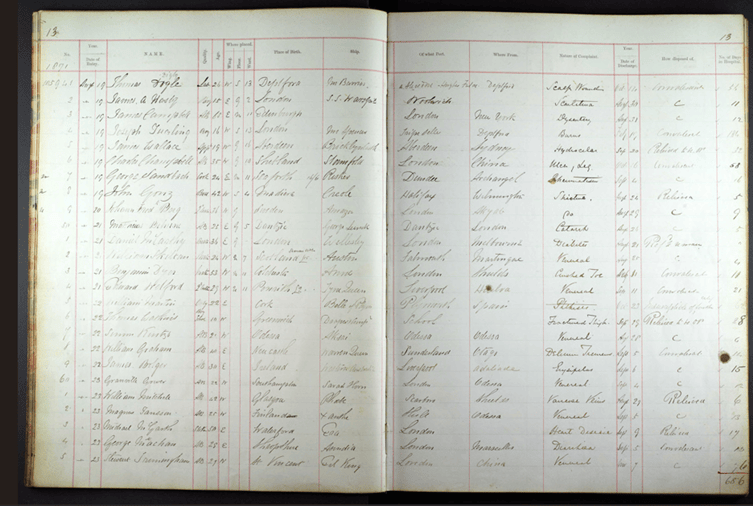
Dreadnought Seaman’s Hospital 1871 – admitted for 32 days with Hydrocele
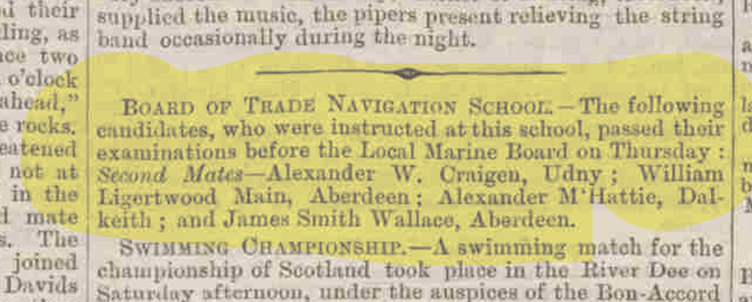
September 1874 – passed 2nd Mate
cd
From: Aberdeen Weekly Journal 11th September 1880
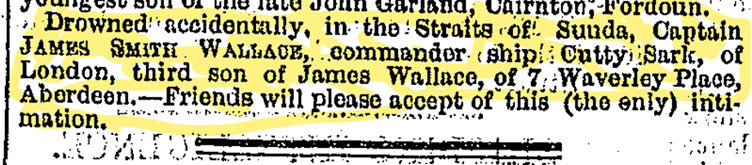
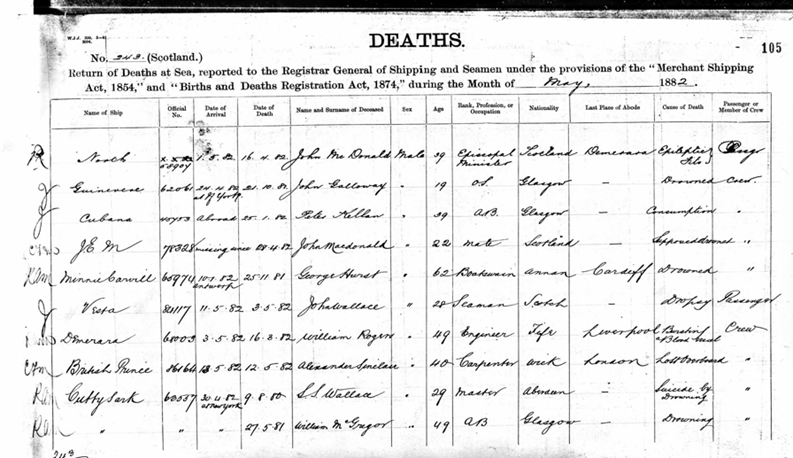
Note: The report of Wallace’s death, was made in May 1882. Interestingly, the report was of TWO deaths from Cutty Sark, the other being that of William McGregor AB, who drowned when Cutty Sark was in port in Melbourne in May 1881.

